Neuro-symbolic AI
What motivates us
While deep learning and neural networks have achieved remarkable success in many domains, they often struggle to incorporate structured domain knowledge and reasoning into their predictions and outputs.
This has led to growing interest in so-called neuro-symbolic AI, which aims at combining elements from both deep learning and automated reasoning, planning, and knowledge representation, in order to achieve the best of both worlds: the flexibility and data-driven performance of deep learning as well as the logical consistency and grounded reasoning of symbolic methods.
Our approach
Neuro-symbolic AI approaches are ideal to exploit the knowledge of domain experts for industrial AI solutions. We develop methods that help leveraging domain experts' knowledge in a way that makes it machine-accessible (e.g., as knowledge graphs), to gain further knowledge via reasoning and prediction, and exploit knowledge for search, exploration, machine learning and problem solving.
Application
We are particularly focusing on applications that leverage Bosch’s existing strength in industrial knowledge graphs. By integrating graph neural network approaches with industrial knowledge graphs, we can develop analytical tools that can answer queries requiring both observational data and explicit rules provided by Bosch domain experts.
Machine learning on knowledge graphs
Knowledge graphs (KGs) are powerful for search and exploration applications. Reasoning can lead to further knowledge and KG validation and thus improved KG quality. With Bosch having lots of know-how in various domains, knowledge needs to be machine accessible (e.g., as KG) to allow for industrial AI solutions. Therefore, neuro-symbolic AI is ideal to exploit the knowledge of domain experts for AI solutions at Bosch. With our work on neuro-symbolic AI we aim to combine symbolic and subsymbolic methods to incorporate (Bosch) domain knowledge into ML models, verify results of ML models, reduce the amounts of training data, and exploit knowledge for search, exploration, and problem solving.
Use case
Machine learning on knowledge graphs
-
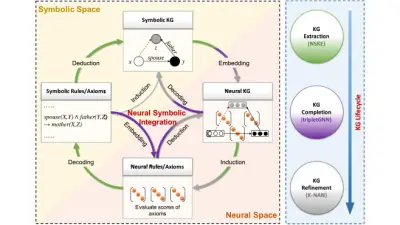
Machine learning with knowledge graphs: integrating structured domain knowledge with neural networks to enable reasoning, prediction, and knowledge completion in industrial AI applications.
Our research
Exploit domain knowledge
We develop methods that allow for integration of rules and structured domain knowledge into machine learning models. These include, for example, ontology-enhanced knowledge graph embedding techniques.

Gaining new insights
Neuro-symbolic AI methods allow to extract new insights from manufacturing data structured in a knowledge graph form. For example, this concerns automatically learning rules and ontologies from the data.
Knowledge graph completion and cleaning
Knowledge graphs (KGs) are often incomplete or of mixed quality. Neuro-symbolic AI methods help to increase the KG quality by detecting inconsistencies or by predicting missing links in KGs.

Advanced AI on top of knowledge graphs
AI methods on top of knowledge graphs allow one to explore and automatically analyze structured knowledge. For example, we develop techniques that simultaneously exploit ontologies and machine learning for answering complex queries over incomplete knowledge graphs, as well as approaches for explainable clustering over symbolic knowledge.
-
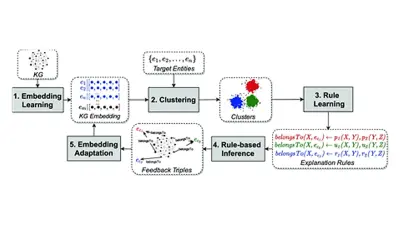
Answer Set Programming for industrial problem solving: declarative approach combining logical reasoning with optimization to solve complex scheduling, configuration, and manufacturing challenges.
References
Feng, W., Zhang, J., Dong, Y., Han, Y., Luan, H., Xu, Q., Yang, Q., Kharlamov, E., & Tang, J. (2020). Graph Random Neural Networks for Semi-Supervised Learning on Graphs. NeurIPS. [PDF]
Gad-Elrab, M.H., Stepanova, D., Tran, T-K., Adel, H., & Weikum, G. (2020). ExCut: Explainable Embedding-based Clustering over Knowledge Graphs. ISWC. [PDF]
Jain, N., Tran, T-K., Gad-Elrab, M.H., & Stepanova, D. (2021). Improving Knowledge Graph Embeddings with Ontological Reasoning. ISWC. [PDF]
Shi, Y., Cheng, G., Tran, T-K., Kharlamov, E., & Shen, Y. (2021). Efficient Computation of Semantically Cohesive Subgraphs for Keyword-Based Knowledge Graph Exploration. WWW. [PDF]
Tran, T-K., Stepanova, D., Kharlamov, E., & Stroetgen, J. (2020) Fast Computation of Explanations for Inconsistency in Large-Scale Knowledge Graphs. WWW. [PDF]
Wang, P-W., Stepanova, D., Domokos, C., & Kolter, Z. (2020). Differentiable Learning of Numerical Rules from Knowledge Graphs. ICLR. [PDF]
Shi, Y., Cheng, G., Tran, T.-K., Tang, J., & Kharlamov, E. (2021). Keyword-Based Knowledge Graph Exploration Based on Quadratic Group Steiner Trees. IJCAI. [PDF]
Knowledge-driven problem solving

Answer-Set Programming (ASP) is a prominent approach to declarative problem solving oriented towards difficult search and optimization problems such as resource allocation, configuration or design of assembly lines.
Rich modeling language and the availability of highly optimized solvers make ASP especially attractive for industry allowing to reduce implementation and maintenance costs as well as improve the man-machine interaction of deployed solutions.
Our research
Scalable rule-based AI methods
We develop AI methods that combine answer set programming with classical optimization techniques (e.g., large neighborhood search) to improve scalability of the resulting systems.


Explainable rule-based AI methods
Explanations are very important in the context of manufacturing optimization, but typically existing solutions are black boxes, which are inaccessible to users. We develop explainable methods that allow for understanding the reasons behind computed solutions.
Combining rule-based methods with neural networks
Machine Learning is data-driven and agnostic to vital experts’ knowledge. To address this, we work on novel AI methods that combine rule-based answer set programming systems with (deep) learning thus allowing for advanced reasoning on top of ML predictions.
Cutting-edge research
Our tools and methods in the area of rule-based, knowledge-driven problem solving result from world-class research of our academic collaborators at the Vienna University of Technology and colleagues at BCAI. We constantly challenge and advance the state-of-the-art in the field, publish at top-tier venues, and exploit the developed methods in real-world Bosch applications.
-
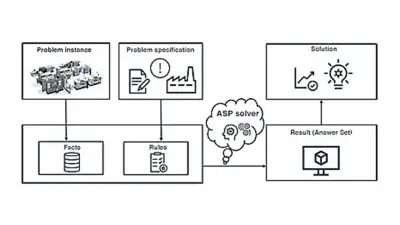
Expert knowledge integration: combining diverse data sources and domain expertise into unified AI systems that leverage both symbolic knowledge and machine learning capabilities.
References
Eiter, T., Higuera, N., Oetsch, J., & Pritz, M. (2022). A Neuro-Symbolic ASP Pipeline for Visual Question Answering. ICLP. [PDF]
Eiter, T., Higuera, N., Oetsch, J., & Pritz, M. (2022). A Confidence-Based Interface for Neuro-Symbolic Visual Question Answering. AAAI. [PDF]
Eiter, T., Geibinger, T., Musliu, N., Oetsch, J., Skocovský, P., & Stepanova, D. (2021). Answer-Set Programming for Lexicographical Makespan Optimisation in Parallel Machine Scheduling. KR 2021: 280-290. [PDF]
Eiter, T., Geibinger, T., Ruiz, N.H., Musliu, N., Oetsch, J., & Stepanova, D. (2022). Large-Neighbourhood Search for Optimisation in Answer-Set Solving. AAAI. [PDF]
Eiter, T., Geibinger, T., Ruiz, N.H., Musliu, N., Oetsch, J., & Stepanova, D. (2022). ALASPO: An Adaptive Large-Neighbourhood ASP Optimiser. KR.